Dopamine Detox: Why Your Brain Craves Endless Scrolling
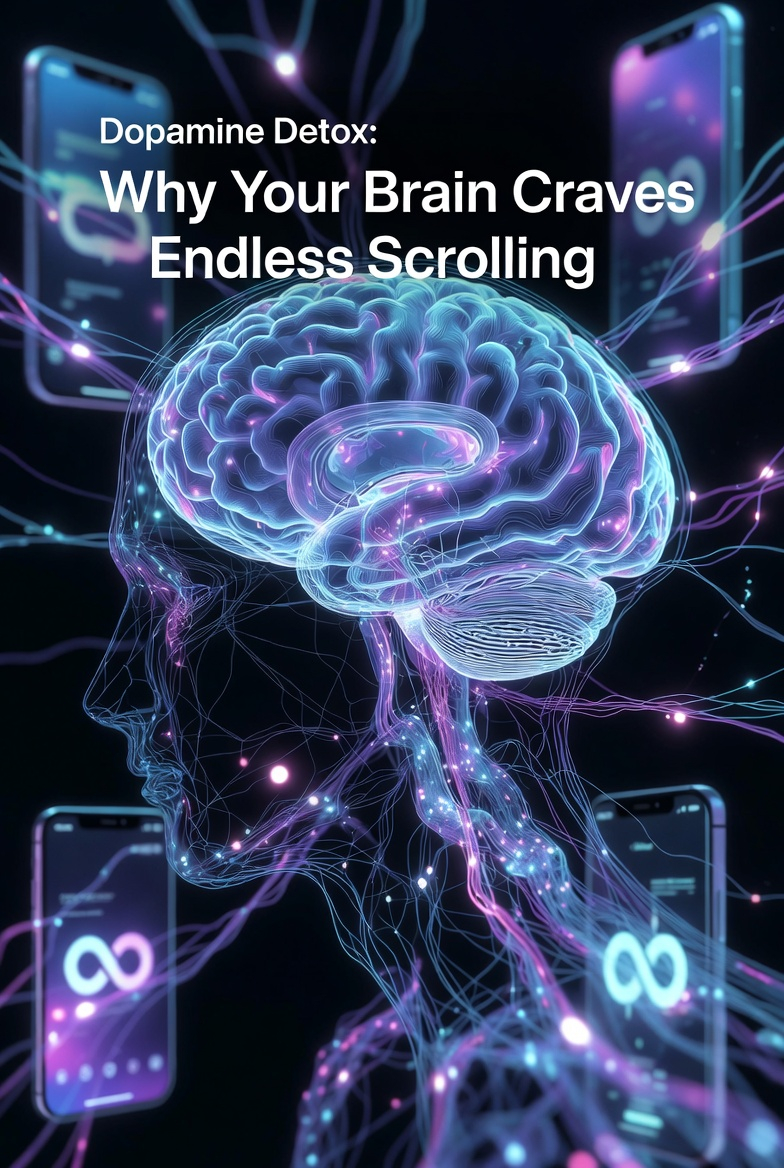
You open your phone to check one thing. Twenty minutes later, you’re watching a stranger organize their fridge. You don’t even care about fridge organization. So why can’t you stop?
The answer isn’t in your character. It’s in your neurochemistry. Specifically, it’s in a molecule called dopamine — and the way modern apps have learned to exploit it.
Dopamine Isn’t What You Think
Most people think dopamine is the “pleasure chemical.” It’s not. Dopamine is the anticipation chemical. It doesn’t reward you for getting something good — it drives you to seek it.
When you hear a notification sound, your brain releases dopamine. Not because the notification is rewarding, but because it might be. That uncertainty — the “maybe something interesting happened” — is exactly what triggers the strongest dopamine response.
Neuroscientist Dr. Anna Lembke, author of Dopamine Nation, explains it this way: the brain treats unpredictable rewards the same way a slot machine works. You don’t know what you’ll get when you pull the lever. That uncertainty is what keeps you pulling.
Your phone is a slot machine in your pocket. Every refresh is another pull of the lever.
How Apps Exploit Your Reward System
This isn’t accidental. App designers use techniques drawn directly from behavioral psychology research:
Variable reward schedules. Your feed isn’t the same every time. Sometimes there’s something great, sometimes nothing interesting. This variability is the most addictive reward pattern known to psychology — more addictive than a guaranteed reward every time.
Infinite scroll. There’s no natural stopping point. In a book, you reach the end of a chapter. On a website, you reach the bottom of a page. In an infinite feed, there’s always more. Your brain never gets the “done” signal that would prompt you to stop.
Social validation loops. Likes, comments, and followers tap into deep social instincts. Every notification that someone interacted with your post delivers a tiny dopamine hit that reinforces the behavior of checking back.
Autoplay. The next video starts before you decide to watch it. The decision to stop requires active effort. The decision to continue requires nothing. In that asymmetry, hours disappear.
The Downregulation Problem
Here’s the part that matters most: your brain adapts. When you flood your dopamine system with constant stimulation — notification after notification, video after video — your receptors become less sensitive. You need more stimulation to feel the same level of engagement.
This is called downregulation, and it’s the same mechanism behind drug tolerance. The result? Activities that used to feel engaging — reading a book, having a conversation, sitting with your thoughts — start feeling boring. Not because they changed, but because your baseline shifted.
You’re not lazy. Your brain has been recalibrated to expect a level of stimulation that real life can’t match.
What a Dopamine Detox Actually Means
A true dopamine detox isn’t about eliminating dopamine — that’s impossible and would be dangerous. It’s about reducing the frequency and intensity of cheap dopamine hits so your brain can recalibrate.
It doesn’t mean: Sitting in a dark room doing nothing for 24 hours.
It does mean: Creating structured periods where high-stimulation apps are off-limits, giving your reward system time to recover.
Think of it like this: if you eat sugar with every meal, fruit starts tasting bland. Cut the sugar for a few weeks, and suddenly an apple is delicious again. The same principle applies to your attention.
Practical Steps to Reset Your Dopamine Baseline
Identify your high-dopamine triggers. For most people, it’s social media, short-form video, and news feeds. These apps are specifically designed for maximum engagement. Know which ones have the strongest pull on you.
Create app-free time blocks. Start with just one or two hours a day where your trigger apps are blocked. Not through willpower — through actual blocking. Remove the option, and the craving fades faster than you’d expect.
Reintroduce low-dopamine activities. Reading, walking, cooking, journaling, stretching — these activities feel boring at first if your brain is overstimulated. That’s normal. After a few days of reduced phone use, they start feeling engaging again. That’s your baseline resetting.
Use the first and last hours wisely. The most impactful change you can make is blocking high-stimulation apps during the first hour after waking and the last hour before sleep. Morning scrolling sets a reactive tone for the whole day. Evening scrolling disrupts melatonin production and sleep quality.
Set daily time limits for specific apps. Unlimited access is the problem. If you know you have 30 minutes of Instagram per day, you’ll use it more intentionally. The limit transforms mindless scrolling into a conscious choice.
The Uncomfortable Truth
Your phone isn’t going away. Digital media isn’t going away. The goal isn’t to live like it’s 1995. The goal is to use technology deliberately instead of being used by it.
That requires more than awareness. It requires structural changes — rules, limits, and tools that create friction between you and the endless scroll. Because the apps on the other side of that screen have billion-dollar engineering teams optimizing for your attention. Willpower alone isn’t a fair fight.
Setting app limits, blocking distractions during focused hours, and tracking your actual usage — these aren’t restrictions. They’re how you level the playing field.
Reclaim Your Attention
Your brain is remarkable. It can recalibrate. It can find depth and engagement in real-world activities again. But it needs the space to do so.
Start small. Block your most addictive app for two hours today. Notice how you feel. Notice the urge to check — and notice that it passes.
That passing is your brain starting to heal.
Ready to take control of your screen time?
Pausify helps you build healthier digital habits. Set app limits, block distractions, and reclaim your time.
Get it on Google Play