5 Signs You're Addicted to Your Phone (And How to Break Free)
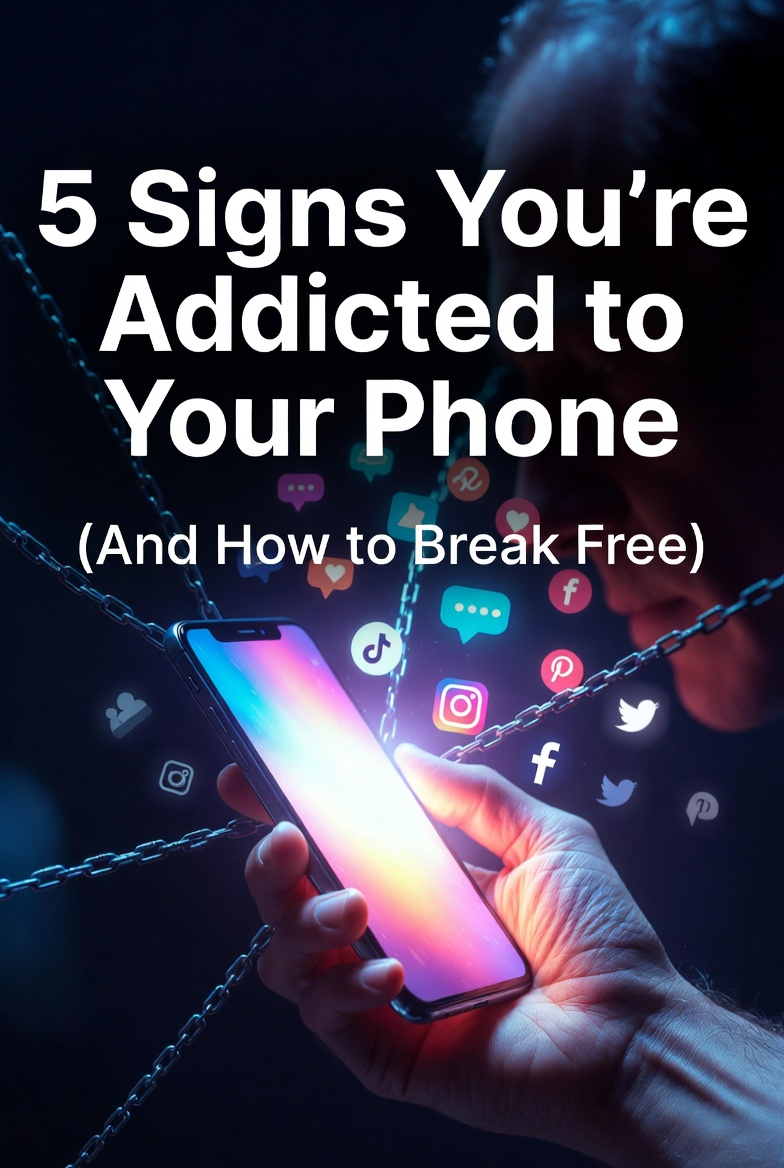
You pick up your phone to check the time. Ten minutes later, you’re deep in Instagram. You didn’t plan it. You barely noticed it happening.
According to research, the average person checks their phone 96 times a day — once every 10 minutes during waking hours. For many of us, the line between normal use and compulsive behavior has quietly disappeared.
Here are five signs that your phone might be using you more than you’re using it.
1. You Reach for It the Moment You Wake Up
Before your feet touch the floor, your thumb is already scrolling. If your phone is the very first thing you interact with each morning — before your partner, before a glass of water, before a single conscious thought — that’s a pattern worth examining.
The first minutes of your day set the tone. Starting with a flood of notifications, news, and social media puts your brain into reactive mode immediately. You’re responding to the world before you’ve even decided what you want from your day.
When your phone is the first thing you reach for, you’re handing control of your morning to an algorithm.
2. You Feel Anxious Without It
There’s a clinical term for this: nomophobia — the fear of being without your mobile phone. If leaving your phone in another room makes you uneasy, or if a dead battery triggers genuine stress, your nervous system has become dependent on the device.
This isn’t about convenience. It’s about the dopamine micro-hits your brain has learned to expect from every notification, every refresh, every new piece of content. Without them, your brain signals that something is wrong.
3. You Use It to Escape Discomfort
Bored in a queue? Phone. Awkward silence? Phone. Feeling low? Phone. If your default response to any form of discomfort is to reach for your device, it’s functioning as an emotional crutch rather than a tool.
The problem isn’t distraction itself — it’s that constant distraction prevents you from developing tolerance for boredom, stillness, and difficult emotions. These are skills your brain needs.
4. You Lose Track of Time While Scrolling
You opened TikTok for “just a second.” Forty minutes vanished. This isn’t a willpower failure — it’s by design. Infinite scroll, autoplay, and algorithmic feeds are engineered to keep you engaged as long as possible.
If you regularly find yourself spending far longer on apps than you intended, you’re experiencing what researchers call time distortion — a hallmark of addictive behavior patterns.
5. You’ve Tried to Cut Back and Failed
This is the most telling sign. You’ve told yourself “I’ll use my phone less.” You’ve set intentions. Maybe you even deleted an app, only to reinstall it days later. The gap between your intention and your behavior is the clearest indicator that something deeper is at play.
Willpower alone doesn’t work against systems designed by hundreds of engineers to capture your attention. You need structural support — tools that create friction between you and the habit.
How to Actually Break Free
Awareness is the first step, but it’s not enough. Here’s what works:
Set hard boundaries. Choose specific hours where certain apps are off-limits. During work, before bed, first thing in the morning. Make the boundary non-negotiable.
Create friction. The easier it is to open an app, the more you’ll do it. Moving apps off your home screen, enabling grayscale mode, or using an app blocker adds a pause between impulse and action — and that pause is where your choice lives.
Replace, don’t just remove. Cutting out scrolling leaves a void. Fill it intentionally: a book, a walk, a conversation. Your brain needs an alternative reward, not just the absence of the old one.
Track your usage honestly. Most people drastically underestimate their screen time. Seeing the real numbers — 4, 5, 6 hours of daily social media — creates the honest reckoning that drives real change.
Use tools built to help, not exploit. The same phone that creates the problem can be part of the solution. Apps designed to block distractions and enforce time limits give you the structural support that willpower alone can’t provide.
The First Step Is the Hardest
You don’t need to go cold turkey. You don’t need to throw your phone away. You just need to start noticing — and then start setting limits that stick.
The fact that you read this far means you already know something needs to change. Trust that instinct.
Ready to take control of your screen time?
Pausify helps you build healthier digital habits. Set app limits, block distractions, and reclaim your time.
Get it on Google Play