The Pomodoro Technique: How Timed Breaks Make You More Productive
You sit down to work. Three hours later, you’ve answered emails, scrolled through news, half-read a report, and started a task you still haven’t finished. You were busy the entire time. You got almost nothing done.
Sound familiar? The problem isn’t laziness. It’s that your brain isn’t designed for sustained, unstructured focus. It needs rhythm — bursts of concentration followed by deliberate recovery.
That’s exactly what the Pomodoro Technique provides.
What Is the Pomodoro Technique?
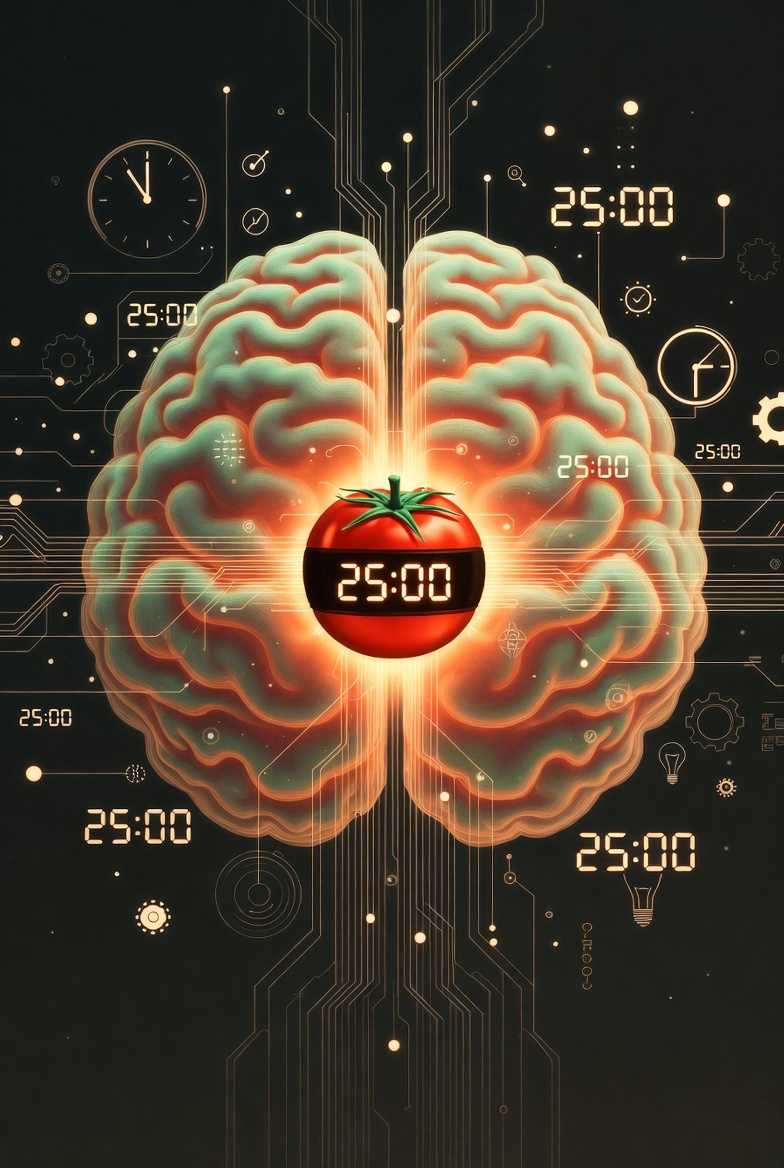
Developed by Francesco Cirillo in the late 1980s, the method is named after the tomato-shaped kitchen timer he used as a university student. The rules are simple:
- Pick a task you want to work on
- Set a timer for 25 minutes — this is one “pomodoro”
- Work on the task only until the timer rings
- Take a 5-minute break
- After 4 pomodoros, take a longer break of 15-30 minutes
That’s the entire system. No apps required, no complex setup, no certification course.
Why 25 Minutes Works
The number isn’t arbitrary. Research in cognitive psychology shows that focused attention begins to degrade after roughly 20-30 minutes. By capping work sessions at 25 minutes, you’re working within your brain’s natural attention window — not fighting against it.
The mandatory break is equally important. During rest, your brain enters what neuroscientists call the default mode network — a state where it consolidates information, makes connections, and prepares for the next round of focus. Skipping breaks doesn’t make you more productive; it makes you more depleted.
Productivity isn’t about working longer. It’s about working in sync with how your brain actually functions.
The Hidden Benefit: Fighting Digital Distraction
Here’s where the Pomodoro Technique becomes especially powerful in the age of smartphones. The 25-minute commitment creates a contract with yourself: for these 25 minutes, nothing else exists.
No checking your phone. No “quick” peek at social media. No responding to non-urgent messages. The timer gives you permission to ignore everything — and a clear endpoint when you can check back in.
For people who struggle with compulsive phone checking, this structure is transformative. You’re not telling yourself “I’ll never check my phone.” You’re saying “I won’t check it for 25 minutes.” That’s manageable. That’s achievable.
Making It Work in Practice
Start with fewer pomodoros. Don’t try to do eight pomodoros on day one. Start with three or four. Build the habit before you build the volume.
Protect the pomodoro ruthlessly. If someone interrupts you, the pomodoro is broken. Note the interruption, restart the timer. This sounds strict, but it teaches you (and others) to respect focused time.
Use breaks for genuine recovery. A break doesn’t mean switching from work scrolling to personal scrolling. Stand up. Stretch. Look out the window. Get water. Your eyes and brain need actual rest, not a different flavor of screen stimulation.
Block distracting apps during work sessions. This is the single most effective upgrade to the technique. If Instagram, TikTok, or Reddit are physically inaccessible during your pomodoro, you eliminate the temptation entirely. You don’t need willpower if there’s nothing to resist.
Track your pomodoros. Knowing that you completed 6 focused pomodoros in a day gives you concrete evidence of productive work. Over time, you’ll learn how many pomodoros different tasks take, making planning easier.
The Pomodoro Technique + Screen Time Management
The Pomodoro Technique addresses the “when” of focus. But it works best when paired with tools that address the “how” — specifically, tools that block distracting apps during your work intervals.
Setting a 25-minute focus session where social media and messaging apps are locked creates an environment where deep work isn’t just possible — it’s the only option. The timer counts down, the distractions are gone, and your brain does what it does best when given the space: it focuses.
Start Your First Pomodoro Today
Set a timer. Pick your most important task. Work for 25 minutes. Take a break.
That’s it. No preparation needed. No optimization required. Just start.
The technique has survived for nearly 40 years because it works with human nature instead of against it. Your brain wants to focus. It just needs the right structure.
Ready to take control of your screen time?
Pausify helps you build healthier digital habits. Set app limits, block distractions, and reclaim your time.
Get it on Google Play